Handley Page Halifax LL505
0.1 miles away
Cumbria
Great Carrs, Coniston, Cumbria / Lake District
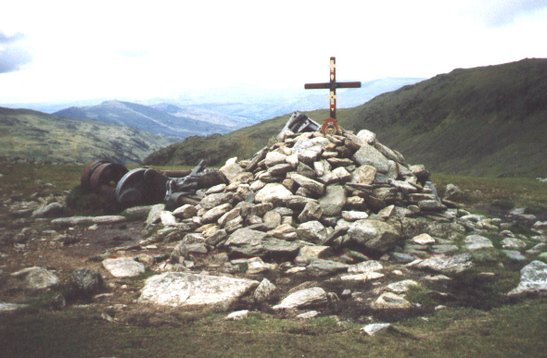
Cairn with wooden cross and plaque on fell; aircraft wreckage remains at site.
Could you help us fill in the inscription?
Great Carrs, Coniston, Cumbria / Lake District, Cumbria
what3words: ///cape.timer.shunning
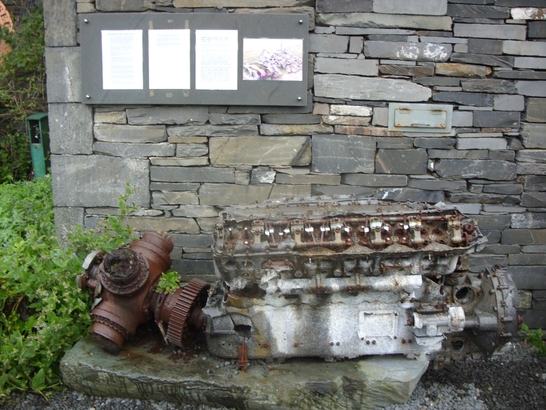
The crew, formed at 82 OTU and posted to 1659 HCU on 9 September 1944, were building hours before joining an operational squadron. Sgt Ferguson had been assigned as their regular flight engineer, while Sgt Pyche was flying as a supernumerary to add logbook hours. As the Halifax flew over the Lake District, it became enveloped in thick cloud. Pilot F/O Johnston descended below the cloud base so his navigator could obtain a visual fix on the ground. But the crew had no knowledge of what lay below. Emerging from cloud, they were confronted by the great rising fells of Swirl How and Great Carrs. There was no time to react. The aircraft, travelling from west to east, failed to clear the ridge by a few feet and went over the edge, crashing far down the precipice. All eight crew were killed. The youngest -- Ferguson and Titt -- were just 19. Six of the seven Canadians are buried together at Blacon Cemetery, Chester, far from home. Over the years, two of the four Rolls-Royce Merlin engines were recovered by RAF helicopter; one is now on display at the Ruskin Museum in Coniston.
The memorial is maintained by Lake District National Park Authority. Kendal Royal British Legion supports the memorial.
Do you know of any commemorative events or annual services held at this memorial? We would love to hear from local communities who remember.
Share remembrance informationKilled when Halifax LL505 failed to clear the ridge of Great Carrs by a few feet. Johnston had descended below cloud to obtain a visual fix but was confronted by the rising fells.
A 27-year-old Canadian pilot from the RCAF, Johnston was building flying hours at 1659 HCU before posting to an operational squadron.
Killed when Halifax LL505 struck the ridge of Great Carrs on 22 October 1944.
Killed when Halifax LL505 struck the ridge of Great Carrs on 22 October 1944.
Killed in the crash. Ferguson was the sole British member of the crew, just 19 years old. He was the crew's regular flight engineer.
The only British member of the crew, Ferguson was assigned as their regular flight engineer. He is buried separately from the Canadians at New Monkland Cemetery, Lanarkshire.
Killed when Halifax LL505 struck the ridge of Great Carrs on 22 October 1944.
Killed when Halifax LL505 struck the ridge of Great Carrs on 22 October 1944.
Killed when Halifax LL505 struck the ridge of Great Carrs on 22 October 1944.
Killed in the crash. Pyche was flying as a supernumerary to add logbook hours, not as part of the regular crew.
Cairn with wooden cross and plaque on fell; aircraft wreckage remains at site.
These local organisations are connected to this memorial and may be able to help with information or visits.
Local remembrance and memorial support
Imperial War Museum register entry for the Halifax LL505 FD-S memorial on Great Carrs. Records the cairn with wooden cross and plaques commemorating the eight crew of 1659 HCU who died on 22 October 1944.
What you'll find: Explore the Great Carrs Halifax Memorial: Discover the poignant tribute to fallen crew members from 1659 HCU.
Memorial reference 13028. Cairn with wooden cross. Metal and slate plaques list all eight names.
War Memorials Online listing for the Halifax LL505 memorial on Great Carrs fell, Lake District. Documents the memorial's remote hillside location and the crew details.
What you'll find: Explore Halifax Memorial Documentation at War Memorials Online.
Memorial reference 175022. Accessible via fell walk from Wrynose Pass or Wetherlam approach.
TracesOfWar entry for the Halifax LL505 'S for Sugar' crash site. Substantial wreckage remains visible including undercarriage components. Two Rolls-Royce Merlin engines were recovered by RAF helicopter; one is on display at the Ruskin Museum, Coniston.
What you'll find: Explore the preserved wreckage and two recovered Rolls-Royce Merlin engines at Halifax LL505 'S for Sugar' crash site.
Six of seven Canadians are buried at Blacon Cemetery, Chester. The sole British crew member (Sgt Ferguson) is buried at New Monkland Cemetery, Lanarkshire. Site is within the Lake District UNESCO World Heritage Site.
Detailed account of the Halifax LL505 crash. The crew took off from Topcliffe at 14:05 and by 18:56 had become lost in thick cloud over the Lake District. The aircraft descended to obtain a visual fix but failed to clear the ridge of Great Carrs by a few feet.
What you'll find: Detailed account of Halifax LL505 crash involving crew's struggle amidst thick clouds over Lake District.
Crew formed at 82 OTU and posted to 1659 HCU on 9 September 1944. Sgt Pyche was flying as a supernumerary to add logbook hours. Bomber remained largely intact after crash; wreckage was cut up and scattered down Broad Slack.
Do you have additional information, photographs, or corrections for this record? We welcome contributions from researchers, families, and local communities.
Suggest a correction or addition